


A Mid-Year Check-In: How the KWP Models, and Markets, are Doing
If you've glanced at the headlines this year, you've probably noticed no shortage of geopolitical conflict and breathless AI news. But behind the noise, it's been a genuinely encouraging year for diversified investors, and for the KWP investment models that anchor most client portfolios. Here's a look at what's been driving performance, both for the year so far and especially in the second quarter.
The Big Picture: Year-to-Date
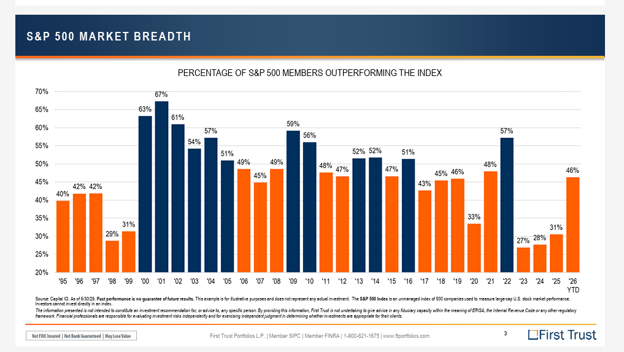
The Market is Broadening Out from Concentrated Performers. The market's leadership has broadened out. For the past few years, a small handful of mega-cap tech names — the so-called "Magnificent Seven" — did most of the heavy lifting for the market. That's changed this year: the Magnificent Seven had lagged the broader market through the first half of 2026, while the other 493 companies in the S&P 500 have stepped up and carried more of the load. It's a healthy shift. A market that isn't leaning so heavily on a handful of stocks is a more resilient one — and it plays right into the kind of broad, quality-focused diversification the KWP models are built around.
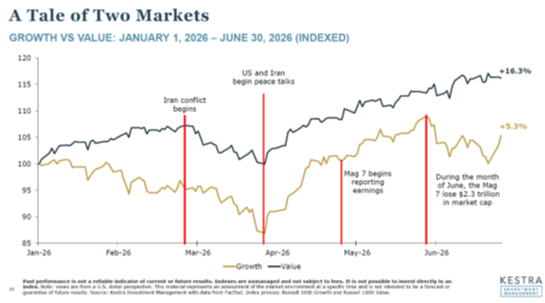
Steady, "boring" companies are having a moment. For years, flashy growth stocks got most of the attention. This year, it's the reliable, cash-generating businesses — the ones that pay steady dividends and trade at reasonable prices — that have quietly led the pack. That's exactly the philosophy behind the KWP models, and it's shown up in the numbers: investors have rewarded companies that can prove they make money today, not just promise to someday. That shift has been one of the single biggest drivers of portfolio gains this year.
Cybersecurity has been the standout story. This one's been hard to miss: the cybersecurity allocation within the KWP models is a top-performer. As AI makes both attackers and defenders more sophisticated, companies and governments are opening their wallets to stay protected. It's a trend we've believed in for a while, even prior to AI being a household buzzword.
Infrastructure has been the quiet workhorse. Airports, pipelines, utilities, and energy networks don't make for exciting dinner conversation, but this allocation within the KWP models has been a top performer as well so far this year. These are the kinds of businesses that keep generating cash no matter what the market is doing day to day — and that consistency has added real stability alongside the returns.
Zooming In: A Strong Second Quarter
Cybersecurity didn't just perform — it took off. After a strong year overall, the sector had one of its best three-month stretches on record in Q2. A flurry of new enterprise security deals, combined with rising AI-driven demand, created ideal conditions. This was arguably the standout contributor to the quarter.
Smaller companies came back in a big way. As geopolitical tensions showed signs of easing and investor confidence returned, smaller, domestically focused businesses regained their footing — and they rallied hard. These positions were added in fall of 2025, as we searched for other areas of the market to broaden beyond the top names.
It wasn't just one or two winners — almost everything worked. Perhaps the most encouraging part of the quarter wasn't any single holding, but how broad the strength was. Dividend growers, value-oriented large companies, and quality growth names all posted solid gains. When performance is this widespread rather than resting on a couple of hot stocks, it's usually a sign of a healthier, more resilient portfolio.
Bonds did their job when markets got bumpy. Back in late March, escalating conflict headlines rattled the markets and briefly pushed portfolios into the red. Through that stretch, bond holdings remained resilient, providing a meaningful cushion while equities absorbed the volatility. Rather than rely on a single bond exposure, the fixed income sleeve is constructed among multiple distinct sub-asset classes, diversifying across credit quality (where we tend to favor the higher-grade credit qualities), rate sensitivity, and geography. That stability helped limit the drawdown and allowed the portfolio to recover quickly. That is the bond sleeve doing exactly what it's designed to do: protect and stabilize when markets get uncomfortable.
The Takeaway
It's been a year and quarter where discipline and diversification have paid off — from steady dividend payers, to a cybersecurity theme years in the making, to bonds quietly cushioning the bumps along the way. Markets will always have their moments of uncertainty (world events and AI headlines included), but broad, balanced participation like we saw this quarter is a healthy sign for the road ahead.
As always, if you'd like to talk through how this applies to your specific portfolio or goals, we're just a call away.